

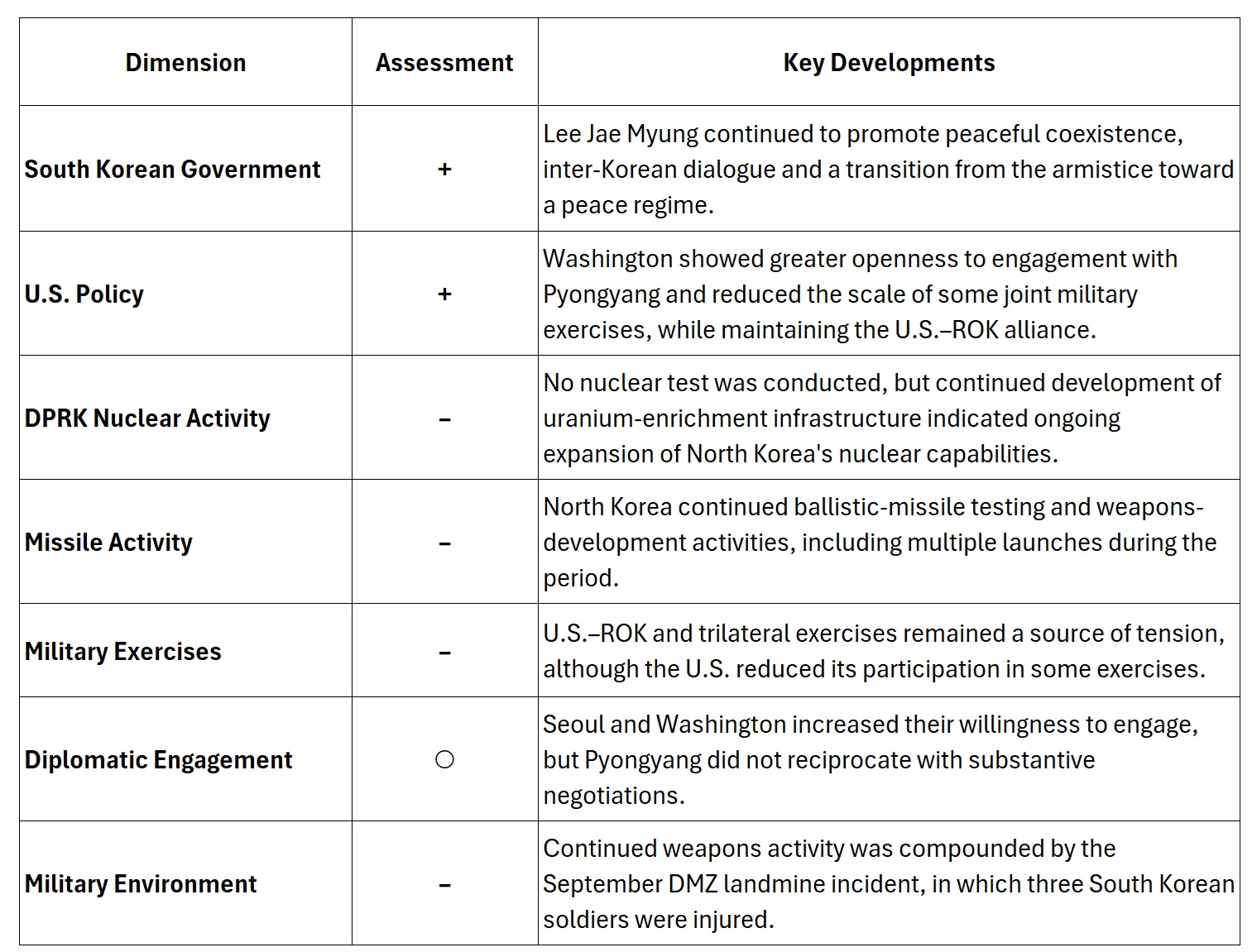
The third quarter of 2026 marked a period of significant contradiction in inter-Korean and North Korea–United States relations. On the political level, both Seoul and Washington displayed greater interest in reducing tensions and creating conditions for renewed engagement with Pyongyang. South Korean President Lee Jae Myung continued to advocate a “peace-first” approach, repeatedly calling for the replacement of the Korean War armistice with a permanent peace regime and for the resumption of inter-Korean and U.S.–North Korean dialogue.
Washington likewise signalled a willingness to reduce some of the military pressure traditionally associated with deterrence on the Korean Peninsula. In August, President Donald Trump ordered a substantial reduction in U.S. participation in joint military exercises with South Korea, explicitly linking the decision to his desire to avoid sending what he regarded as an unnecessarily hostile signal to Pyongyang.
Yet these political openings did not produce a corresponding response from North Korea. Pyongyang remained largely unresponsive to Seoul's repeated diplomatic initiatives while continuing to consolidate its nuclear and missile capabilities. The International Atomic Energy Agency reported in September that North Korea had constructed a new uranium-enrichment facility at Yongbyon, potentially capable of accommodating up to 28 centrifuge cascades.
At the same time, military tensions increased. North Korea conducted multiple missile launches in connection with U.S.–South Korean and trilateral exercises, including a launch of more than ten short-range ballistic missiles in August. In September, further weapons tests and integrated firepower exercises were conducted following the Freedom Edge exercise involving South Korea, the United States and Japan.
The period concluded with a particularly significant border incident. On September 21, three South Korean soldiers were injured by a landmine in the Demilitarized Zone. A joint South Korean–United Nations Command investigation concluded that the mine was of North Korean origin, while Pyongyang rejected the accusation and warned of retaliation should South Korean forces attack North Korean personnel operating near the border.
The third quarter therefore did not constitute a return to the extreme confrontation of 2017. Instead, it demonstrated the coexistence of two opposing trajectories: political efforts toward de-escalation and a military environment characterized by continuing deterrence, weapons development and renewed incidents along the inter-Korean border.
Strategic Context
The strategic environment during this period was shaped by the interaction of three developments.
First, Seoul continued to pursue a fundamentally different approach from the confrontation-oriented policies that had characterized the preceding Yoon administration. President Lee sought to normalize the concept of peaceful coexistence between the two Korean states, while maintaining South Korea's alliance with Washington. In July, Lee reiterated that Seoul would continue attempting to create the diplomatic conditions necessary for both inter-Korean and U.S.–North Korean dialogue.
Second, Washington demonstrated greater flexibility regarding military exercises. Trump's August decision to reduce the scale of the U.S. contribution to Ulchi Freedom Shield represented a notable departure from the trajectory of expanded alliance exercises observed during the 2022–2025 period. The decision was partly motivated by broader U.S. strategic considerations, but Trump also explicitly presented the reduction as consistent with his interest in improving relations with Kim Jong Un.
Third, North Korea continued to behave as a nuclear-armed state seeking to consolidate rather than relinquish its strategic capabilities. Its rejection of international calls to halt nuclear testing and its assertion that its nuclear status is irreversible demonstrated that Pyongyang's strategic position had not fundamentally changed.
Consequently, the central question of the period was no longer simply whether Washington or Seoul was willing to engage. Both demonstrated such willingness. The more difficult question was whether Pyongyang was prepared to reciprocate without requiring prior recognition of its nuclear status or fundamental changes to the alliance structure surrounding the Korean Peninsula.
South Korean Government
President Lee Jae Myung continued to represent the most important positive political factor in the NKIO Index during the period.
On July 1, Lee stated that Seoul would continue efforts to engage North Korea and replace the armistice with a peace regime. Later in July, his administration explicitly described its approach as “peace-first,” moving away from the previous emphasis on denuclearization as a prerequisite for meaningful engagement.
Lee also repeatedly sought to facilitate U.S.–North Korean dialogue rather than limiting his policy to inter-Korean relations. On July 27, he stated that South Korea would work to create conditions conducive to the resumption of both inter-Korean and U.S.–North Korean negotiations.
The most consequential initiative came on August 15, when Lee proposed direct discussions between the two Koreas aimed at formally ending the Korean War and replacing the armistice with a peace regime. He also indicated that such discussions could address practical measures to halt the further development of North Korea's nuclear capabilities.
North Korea, however, did not publicly respond to the proposal.
This distinction is important for the NKIO Index. Seoul's policy environment became substantially more conducive to engagement, but the relationship itself did not improve to the same degree because the principal counterpart did not reciprocate.
At the same time, Lee did not abandon deterrence or the U.S.–South Korean alliance. His government maintained military readiness and continued participating in combined exercises, even as Washington sought to reduce their scope.
United States Policy
U.S. policy during the period was characterized by an unusual combination of diplomatic openness and uncertainty concerning the future structure of regional deterrence.
President Trump continued to express a willingness to engage directly with Kim Jong Un. His administration also moved to reduce the scale of U.S. participation in major exercises with South Korea. On August 16, Trump instructed the Pentagon to substantially reduce the joint exercises, describing them as costly and arguing that they sent an inappropriate message to North Korea.
The change was significant because military exercises had been one of the most persistent sources of North Korean criticism. From Pyongyang's perspective, their reduction could therefore be interpreted as a potentially meaningful confidence-building measure.
North Korea nevertheless did not respond by suspending its own military activities. Instead, Pyongyang denounced the exercises and threatened to respond with a stronger deterrent.
The U.S.–South Korean alliance also remained intact. Seoul continued to affirm the defensive character of the alliance, while bilateral cooperation remained substantial in areas of military technology and regional security. In September, the United States approved South Korea's construction of its first nuclear-powered submarine, a development North Korea immediately criticized as contributing to regional instability.
The resulting picture was therefore ambiguous: Washington reduced one traditional source of tension while simultaneously deepening other dimensions of allied military capability.
North Korean Behaviour
North Korean behaviour represented the principal negative factor during the period.
Pyongyang continued to reject the political premises underlying Seoul's peace initiative. Despite repeated calls for dialogue, North Korea remained largely silent toward Lee's proposals and continued to emphasize its status as a nuclear-armed state.
Its nuclear infrastructure also continued to expand. In September, the IAEA reported the construction of a new uranium-enrichment facility at Yongbyon, potentially capable of accommodating up to 28 centrifuge cascades. The agency expressed concern that the development could contribute to continued production of weapons-grade nuclear material.
North Korea simultaneously maintained an active missile-testing programme. More than ten short-range ballistic missiles were launched in August as the U.S.–South Korean Ulchi Freedom Shield exercise was taking place. In September, additional ballistic-missile and integrated firepower exercises followed the Freedom Edge exercise involving South Korea, the United States and Japan.
These activities did not amount to a return to the strategic escalation of 2017: there was no nuclear test and no long-range missile launch comparable to the ICBM demonstrations of that period. Nevertheless, they demonstrated that the absence of nuclear testing should not be interpreted as evidence of a reversal in North Korea's nuclear strategy.
Diplomatic Engagement
Diplomatic activity increased primarily on the side of Seoul and Washington, rather than through reciprocal negotiations with Pyongyang.
Lee repeatedly proposed dialogue and peaceful coexistence. His government explicitly sought to revive both inter-Korean and U.S.–North Korean diplomacy. In September, Lee again described himself as a potential facilitator of renewed U.S.–North Korean engagement.
The United States simultaneously adopted a more flexible posture toward military exercises, creating at least one potential avenue for reducing tensions.
Yet no substantive three-way diplomatic process emerged during the period. North Korea did not accept Seoul's proposals for talks, while continuing to insist on its status as a nuclear-armed state. In this sense, the period demonstrated a persistent structural problem: the willingness of Seoul and Washington to modify aspects of their policy did not automatically generate reciprocal concessions from Pyongyang.
Military Environment
The military environment deteriorated during the third quarter.
The August Ulchi Freedom Shield exercise remained a major point of contention, despite the subsequent reduction in U.S. participation. North Korea described the exercise as hostile and threatened a stronger deterrent response.
The September Freedom Edge exercise involving South Korea, the United States and Japan generated further North Korean criticism. The exercise proceeded as planned, with increased emphasis on interoperability and information-sharing among the three countries.
North Korea responded with additional weapons activity, including missile launches and a larger integrated firepower exercise incorporating multiple weapons systems.
The most consequential event occurred on September 21, when three South Korean soldiers were injured by a landmine while clearing a patrol route near the DMZ. A subsequent investigation by South Korean authorities and the United Nations Command concluded that the mine was North Korean. Pyongyang rejected the finding and accused Seoul of fabricating evidence.
The incident is particularly significant in historical perspective because of its resemblance to the August 2015 landmine crisis included in Period II of the NKIO Index. Unlike 2015, however, the political relationship in 2026 lacked the established inter-Korean channels that had facilitated de-escalation at that time.
Assessment of the NKIO Index
The third quarter of 2026 produced simultaneous positive and negative signals, making it a particularly revealing period for the NKIO Index.
The political orientation of Seoul was clearly conducive to engagement. President Lee repeatedly proposed dialogue, peaceful coexistence and a formal transformation of the armistice system. Washington also showed a willingness to reduce military exercises and preserve the possibility of direct engagement with Kim Jong Un.
However, these developments were not matched by a corresponding change in Pyongyang's strategic posture. North Korea continued to expand its nuclear infrastructure, conduct ballistic-missile tests, reject denuclearization as a meaningful premise for negotiations, and reinforce its military position along the inter-Korean border. The September DMZ mine incident further demonstrated that the potential for localized military escalation remained real.
The period therefore does not justify a return toward the levels recorded during the 2018 diplomatic opening. Nor does it represent a simple continuation of the severe confrontation observed in 2022–2024.
Rather, it represents a new form of strategic ambiguity: the principal external actors increasingly expressed an interest in reducing tensions, while North Korea continued to strengthen the capabilities and political doctrines that had produced those tensions in the first place.
NKIO Index Assessment: 3.0 / 10
The score reflects a relationship that remains substantially closer to strategic confrontation than to meaningful peace negotiations, but in which the political environment in Seoul and Washington has become more receptive to diplomatic engagement than during the preceding period.
The defining characteristic of the quarter is therefore not rapprochement itself, but the emergence of an opening whose principal obstacle remains the absence of reciprocal movement from Pyongyang.