

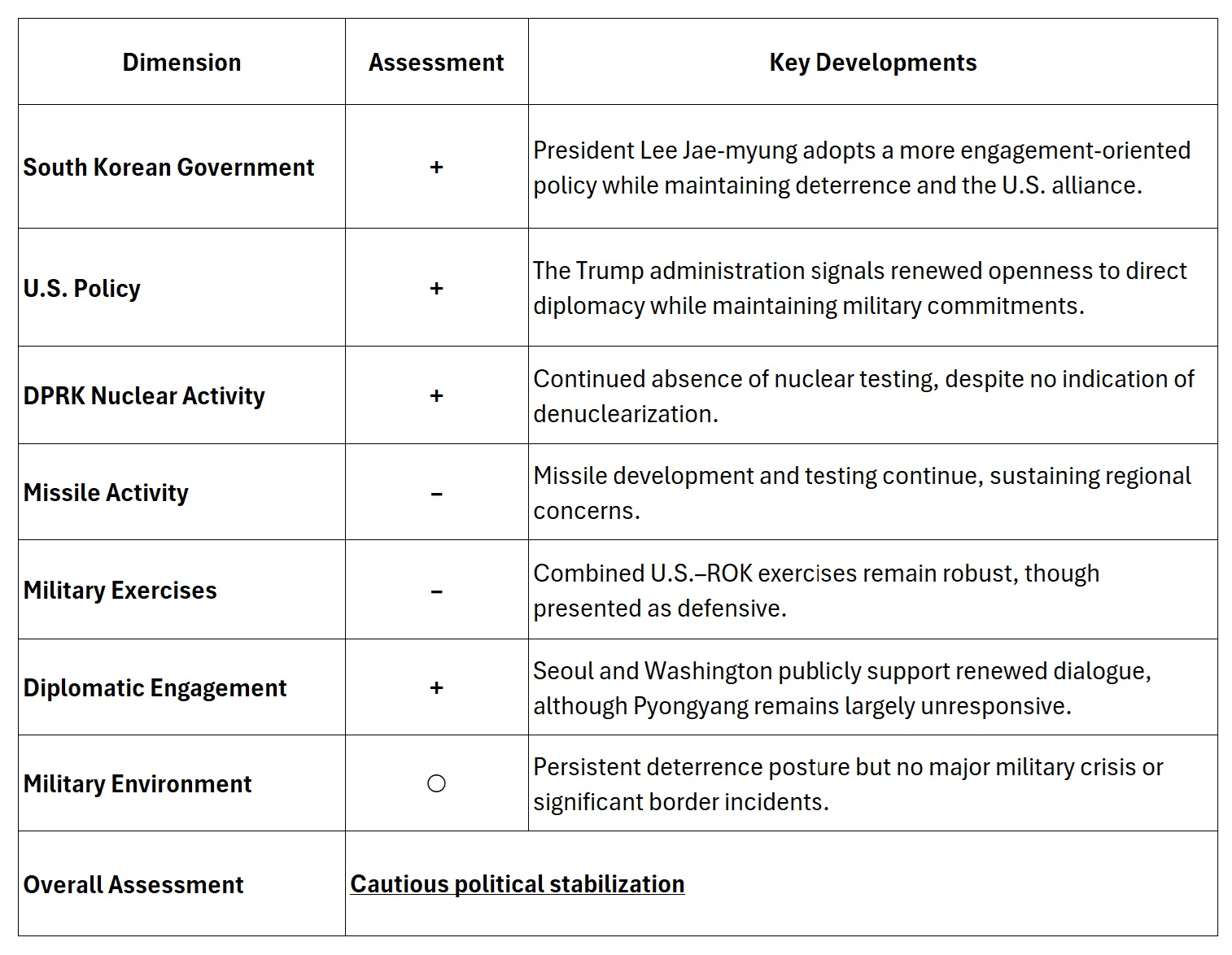
The period beginning in 2025 marks a modest but meaningful improvement in the overall political climate on the Korean Peninsula. While the fundamental strategic disagreements separating North Korea from the South Korea–United States alliance remain unresolved, changes in political leadership in both Seoul and Washington have contributed to a less confrontational diplomatic environment than that observed in 2024. The improvement reflected in this period should not be interpreted as a return to the diplomatic optimism of 2018, nor as evidence that the underlying security situation has fundamentally changed. Rather, it reflects a renewed willingness among key policymakers to avoid unnecessary escalation and to preserve the possibility of future dialogue. A NKIO index score of 3.5/10 therefore represents cautious political stabilization within a relationship that remains characterized by profound strategic mistrust.
The most significant development influencing the index score during this period has been the change of government in South Korea. Following the election of President Lee Jae-myung, Seoul has adopted a noticeably more conciliatory approach toward North Korea than the previous administration. Although the new government has reaffirmed South Korea's commitment to the U.S. alliance and national defense, it has simultaneously expressed a renewed willingness to pursue dialogue, reduce tensions, and rebuild channels of inter-Korean communication whenever conditions permit. This shift does not immediately alter North Korea's policies, but it significantly changes the political atmosphere surrounding the relationship.
A second important factor has been the return of Donald Trump to the U.S. presidency. While maintaining the United States' security commitments toward South Korea and Japan, the Trump administration has once again emphasized the potential value of direct leader-to-leader diplomacy with Kim Jong Un. Unlike the period of "Fire and Fury" in 2017, official rhetoric has generally avoided explicit military threats and instead focused on the possibility—however uncertain—of future negotiations. Although no comprehensive diplomatic initiative has yet emerged, the administration's political posture has contributed to reducing perceptions of immediate crisis.
North Korea, however, has shown little indication that it intends to reverse the strategic decisions adopted in 2024. Official statements continue to characterize South Korea as a hostile state, and Pyongyang has not reinstated reunification as a national objective. Missile development remains an important priority, and military modernization continues. Consequently, the principal structural sources of tension on the peninsula remain firmly in place.
Nevertheless, one significant stabilizing factor continues to distinguish the current period from earlier crises. North Korea has still not conducted another nuclear test, extending the absence of nuclear testing to several consecutive years. While this restraint should not be interpreted as denuclearization or a reduction in military capability, it has prevented one of the most destabilizing forms of strategic signaling from reappearing. Combined with the absence of major conventional military incidents, this has contributed to a more predictable security environment than during previous periods of acute confrontation.
Military cooperation between the United States and South Korea continues at a high level, reflecting persistent concerns regarding North Korea's military capabilities. Joint exercises remain an important component of alliance readiness, although both Seoul and Washington have generally sought to frame these activities as defensive rather than coercive. At the same time, neither side has demonstrated an interest in provoking a crisis comparable to that of 2017.
Diplomatic engagement remains limited but no longer appears entirely absent. Public statements by South Korean officials have repeatedly emphasized the importance of restoring communication with Pyongyang, while Washington has continued to express its willingness to engage in dialogue without preconditions. North Korea has not reciprocated these overtures in any meaningful way, yet the overall tone of regional politics has become less confrontational than during the preceding year.
Overall, the period beginning in 2025 illustrates that political intentions can improve even when strategic realities remain largely unchanged. The election of a more engagement-oriented government in Seoul and the return of an American administration expressing renewed interest in direct diplomacy have modestly improved the atmosphere surrounding the Korean Peninsula. At the same time, North Korea's continued military modernization, its revised doctrine toward South Korea, and the absence of substantive negotiations continue to constrain prospects for lasting reconciliation. Consequently, a NKIO Index score of 3.5/10 appropriately reflects a period of cautious political improvement without implying that the peninsula has entered a genuine process of détente.