

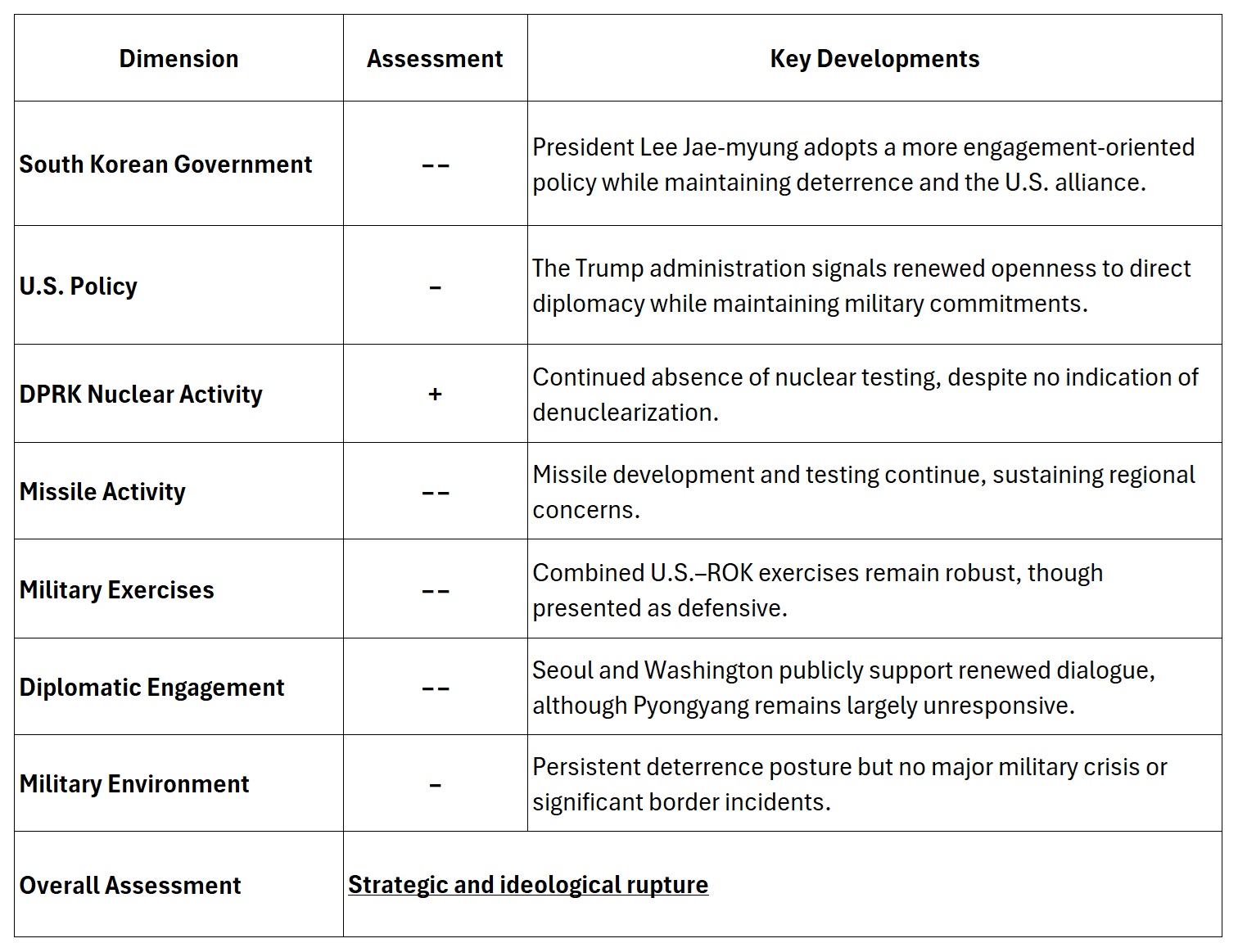
The year 2024 represents a watershed in the evolution of inter-Korean relations during the Kim Jong Un era. Unlike previous periods, in which military tensions fluctuated while the long-term objective of national reunification formally remained intact, 2024 witnessed a fundamental transformation of North Korea's official policy toward South Korea. Kim Jong Un openly abandoned the longstanding objective of peaceful reunification and redefined the Republic of Korea as a separate and permanently hostile state. This ideological and strategic shift fundamentally altered the political foundations of relations on the Korean Peninsula. Although the year did not witness a major military crisis or a renewed cycle of nuclear testing, the institutionalization of hostility significantly reduced the prospects for future reconciliation. Consequently, a NKIO Index score of 2.0/10 reflects a relationship characterized by profound political estrangement despite the absence of imminent armed conflict.
The defining event of the year occurred during meetings of the Workers' Party of Korea in early 2024, when Kim Jong Un declared that the long-standing policy of peaceful reunification had become obsolete. He argued that North and South Korea should no longer be regarded as members of a single nation temporarily divided, but rather as two separate states locked in an enduring adversarial relationship. This represented one of the most consequential ideological shifts in North Korean policy since the establishment of the Democratic People's Republic of Korea in 1948.
This doctrinal transformation was accompanied by concrete political measures. North Korea dismantled several institutions historically responsible for managing inter-Korean relations and abolished organizations dedicated to promoting reunification. Symbols associated with eventual national unity largely disappeared from official discourse, while state media increasingly described South Korea as the DPRK's "principal enemy." These developments suggested that Pyongyang was no longer seeking to manage temporary political differences within a shared national identity, but rather to redefine the relationship as one between two permanently separate sovereign states.
South Korea, under President Yoon Suk Yeol, maintained its emphasis on deterrence and alliance cooperation. Seoul strongly condemned North Korea's revised policy and continued to strengthen military preparedness in close coordination with the United States. While the South Korean government repeatedly stated that dialogue remained possible, its immediate priority focused on reinforcing national defense and responding to the evolving security environment created by Pyongyang's increasingly confrontational posture.
The United States likewise maintained its commitment to extended deterrence and alliance coordination. Military cooperation with South Korea continued at a high level, while trilateral security cooperation with Japan became increasingly institutionalized. Washington consistently emphasized that diplomacy remained the preferred solution to the nuclear issue but simultaneously expanded strategic military deployments designed to reassure regional allies. As a result, deterrence rather than engagement became the dominant organizing principle of U.S. policy on the Korean Peninsula.
North Korea continued to advance its military capabilities throughout the year. Missile testing remained frequent, demonstrating ongoing efforts to improve both strategic and tactical delivery systems. However, one notable stabilizing factor persisted: Pyongyang once again refrained from conducting a nuclear test. By the end of 2024, more than seven years had elapsed since the sixth nuclear test in September 2017. While this restraint did not indicate a reversal of North Korea's nuclear ambitions, it reduced one of the most destabilizing elements that had characterized previous crises.
Diplomatic engagement remained virtually nonexistent. No significant inter-Korean meetings took place, negotiations with the United States remained suspended, and political communication was limited to reciprocal public statements. The atmosphere of mutual confidence established during 2018 had effectively disappeared. Nevertheless, military forces on both sides generally avoided direct confrontation, and no major conventional incidents comparable to earlier crises occurred along the Demilitarized Zone.
Overall, 2024 represents less a year of escalating military confrontation than a year of strategic and ideological rupture. North Korea's abandonment of reunification as a national objective fundamentally reshaped the political context within which future diplomacy would occur. Although the continued absence of nuclear testing and the avoidance of direct military clashes prevented the relationship from reaching the exceptional danger of 2017, the institutionalization of permanent hostility significantly diminished the prospects for meaningful rapprochement. Consequently, a NKIO Index score of 2.0/10 appropriately reflects one of the lowest levels of political confidence observed during the Kim Jong Un era while recognizing that the peninsula remained below the threshold of imminent war.