

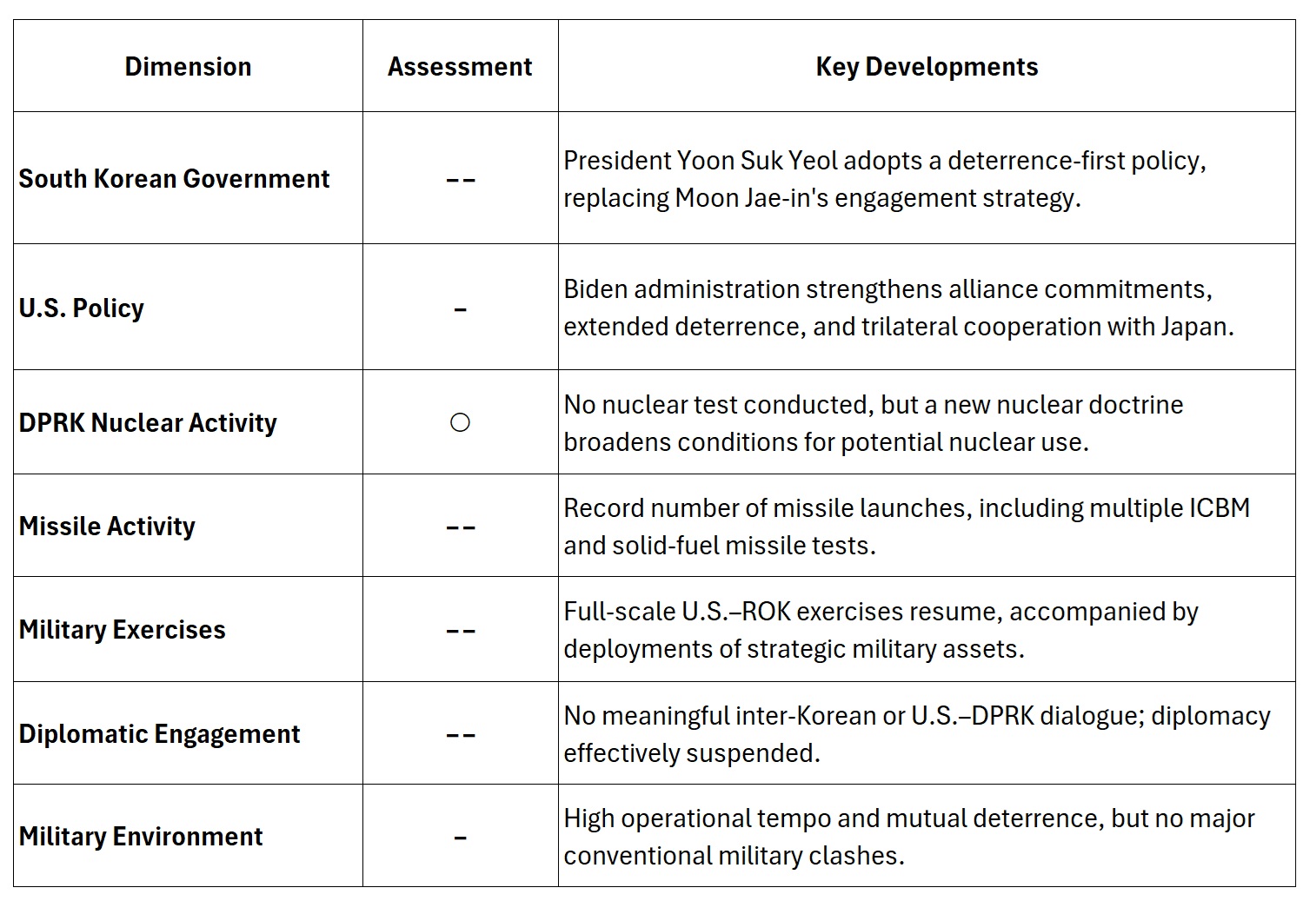
The years 2022 and 2023 marked a decisive deterioration in relations on the Korean Peninsula and the emergence of a new phase of long-term strategic confrontation. Following several years of diplomatic stagnation, political engagement was largely replaced by an intensified emphasis on deterrence, military modernization, and alliance strengthening. The election of South Korean President Yoon Suk Yeol fundamentally altered Seoul's approach toward Pyongyang, while North Korea accelerated its missile development at an unprecedented pace and adopted a more assertive nuclear posture. Although the peninsula did not experience a crisis comparable to that of 2017, the cumulative effect of these developments significantly reduced prospects for renewed dialogue. A NKIO Index score of 2.5/10 reflects a relationship characterized by deepening hostility, sustained military competition, and the near absence of meaningful diplomatic engagement.
The most significant political development of this period was the inauguration of President Yoon Suk Yeol in May 2022. Unlike his predecessor, Moon Jae-in, whose administration prioritized reconciliation and confidence-building measures, Yoon adopted a strategy centered on deterrence, alliance solidarity, and military preparedness. While his government maintained that dialogue with North Korea remained possible, it insisted that negotiations should be supported by credible military strength rather than unilateral concessions. This represented a fundamental shift in South Korean policy and significantly altered the political environment in which inter-Korean relations evolved.
The United States strongly supported this new approach. The Biden administration expanded security cooperation with Seoul and placed renewed emphasis on strengthening extended deterrence. Combined military exercises, which had been reduced or modified during the diplomatic engagement of 2018–2020, resumed on a much larger scale. Exercises such as Ulchi Freedom Shield and other joint operations incorporated increasingly realistic scenarios designed to improve allied readiness. In parallel, the United States resumed the deployment of strategic assets—including nuclear-capable bombers, aircraft carriers, and nuclear-powered submarines—to the Korean Peninsula, reinforcing its commitment to South Korea's defense.
North Korea responded by dramatically accelerating the pace of its missile testing program. During 2022, Pyongyang conducted a record number of missile launches, including multiple intercontinental ballistic missiles capable of reaching the continental United States. Throughout 2023, the regime continued testing increasingly sophisticated delivery systems, including solid-fuel ICBMs, submarine-launched ballistic missiles, and military reconnaissance satellites. These developments demonstrated Kim Jong Un's determination to diversify and modernize North Korea's strategic deterrent despite international sanctions.
Although North Korea refrained from conducting a seventh nuclear test, the regime significantly strengthened its nuclear doctrine. In September 2022, the Supreme People's Assembly adopted a new nuclear policy law that broadened the circumstances under which nuclear weapons could be employed, including provisions regarding pre-emptive nuclear use under specific conditions. This legislative change represented an important strategic development, suggesting that Pyongyang viewed its nuclear arsenal as a permanent and expanding component of national defense rather than as a bargaining instrument for future negotiations.
Diplomatic engagement declined to its lowest level since the end of the 2018–2019 dialogue process. No high-level inter-Korean meetings took place, formal negotiations with the United States remained suspended, and communication channels between Seoul and Pyongyang became increasingly limited. At the same time, trilateral cooperation among South Korea, the United States, and Japan expanded considerably. The Camp David Summit in August 2023 institutionalized closer security coordination among the three governments, an initiative welcomed by Seoul and Washington but denounced by North Korea as evidence of an increasingly hostile regional security architecture.
The military environment remained tense throughout the period. Frequent missile launches, large-scale allied exercises, strategic bomber flights, and repeated demonstrations of military capabilities reinforced a cycle of reciprocal deterrence. Nevertheless, despite the heightened level of military activity, no major conventional clashes occurred along the Demilitarized Zone or the Northern Limit Line, and neither side appeared willing to provoke a direct armed confrontation.
Overall, the years 2022 and 2023 marked the consolidation of a new strategic equilibrium based primarily on deterrence rather than dialogue. The return of a more security-oriented South Korean government, the strengthening of the U.S.–ROK alliance, the unprecedented expansion of North Korea's missile program, and the effective suspension of diplomatic engagement collectively produced one of the lowest levels of political trust observed during the Kim Jong Un era. However, the continued absence of nuclear testing and the avoidance of an immediate military crisis distinguish this period from the exceptional confrontation of 2017. Consequently, a NKIO score of 2.5/10 accurately reflects a relationship dominated by structural hostility, yet falling short of imminent conflict.