

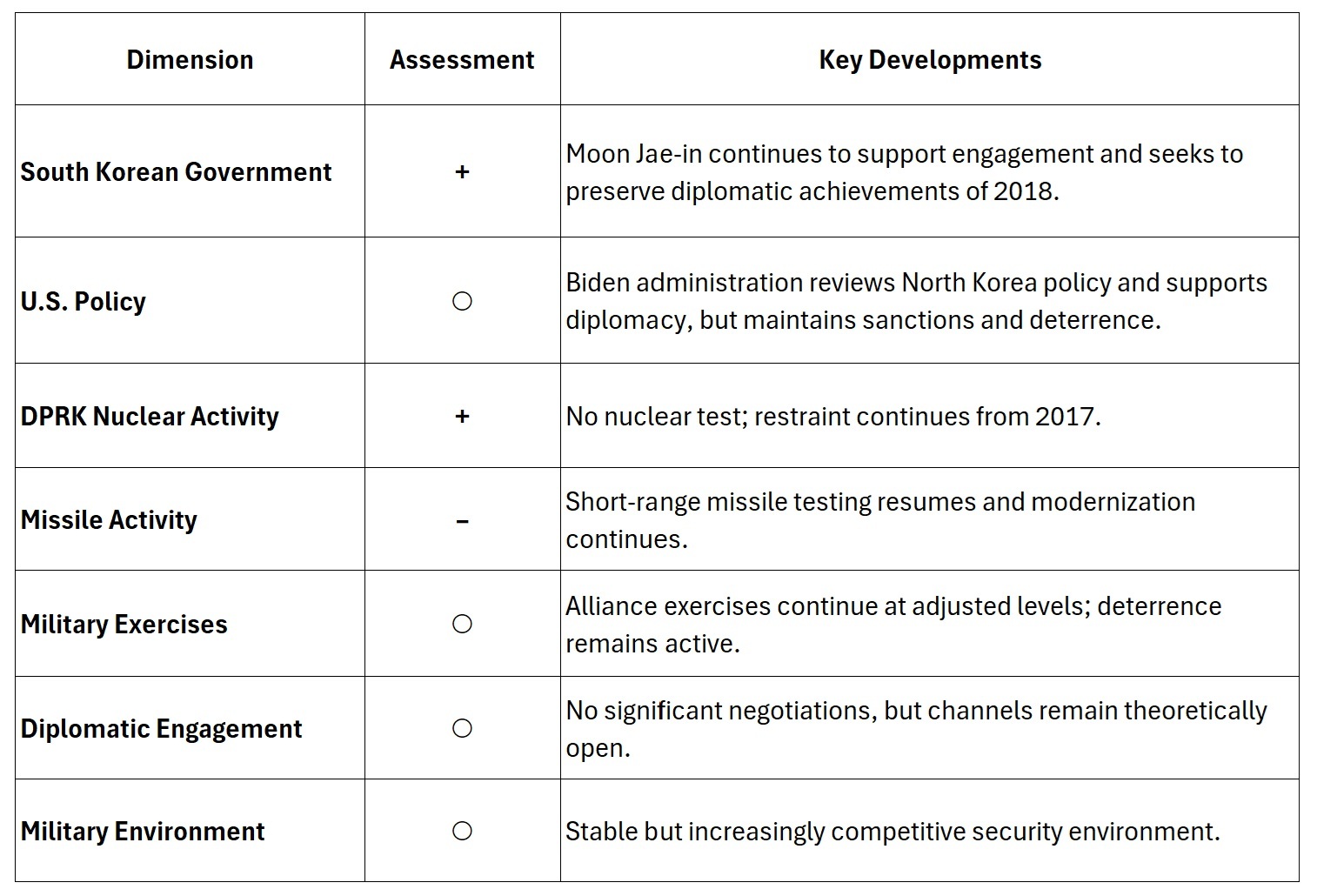
The year 2021 represents a transitional phase in relations between North Korea and the South Korea–United States alliance. Following the collapse of diplomatic momentum after the Hanoi Summit and the deterioration of inter-Korean relations in 2020, the peninsula entered a period characterized by strategic uncertainty rather than open confrontation. The transition from the Trump administration to the Biden administration created expectations of a possible reassessment of U.S. policy, while South Korean President Moon Jae-in continued to advocate diplomatic engagement until the end of his term. However, the absence of meaningful negotiations, combined with growing mistrust and the gradual return of military competition, prevented a significant improvement in relations. A NKIO Index score of 5.0/10 reflects a relationship that had returned to a state of cautious rivalry: more stable than the crises of 2017 or 2022–2023, but significantly less cooperative than during the diplomatic opening of 2018.
The most important political development of the year was the inauguration of U.S. President Joe Biden in January 2021. The new administration immediately initiated a review of American policy toward North Korea, signaling a desire for a more pragmatic and calibrated approach compared with both the strategic patience of the Obama administration and the leader-driven diplomacy of the Trump administration. Washington emphasized a willingness to pursue diplomacy while maintaining pressure through sanctions and alliance commitments. This approach was intended to create a middle ground between unconditional engagement and maximum pressure.
However, the Biden administration's arrival did not immediately produce a diplomatic breakthrough. North Korea responded cautiously, maintaining a significant distance from Washington and Seoul. Pyongyang criticized U.S. policies as fundamentally hostile and demanded a change in approach before meaningful negotiations could resume. Unlike in 2018, when personal diplomacy between leaders created rapid momentum, no comparable channel emerged in 2021.
South Korean President Moon Jae-in continued to prioritize inter-Korean reconciliation during his final year in office. Having invested significant political capital in the diplomatic achievements of 2018, Moon sought to preserve the possibility of renewed dialogue and repeatedly encouraged Washington and Pyongyang to return to negotiations. His administration supported initiatives aimed at reducing tensions, including discussions regarding a possible declaration of the formal end of the Korean War. However, domestic political constraints, North Korea's reluctance to engage, and differences between Seoul and Washington limited progress.
North Korea's military behavior during 2021 reflected a combination of restraint and continued modernization. The most significant positive factor was the continued absence of nuclear tests and long-range ICBM launches, maintaining the restraint that had begun in 2018. This prevented a return to the crisis atmosphere of 2017 and suggested that Pyongyang continued to view its strategic patience as beneficial. Nevertheless, North Korea conducted several missile tests, including short-range ballistic missile launches, demonstrating that its missile development program remained active despite diplomatic stagnation.
The military environment became increasingly competitive during the year. The United States and South Korea maintained their alliance posture and resumed some combined military activities after previous adjustments caused by diplomatic considerations and the COVID-19 pandemic. Although these exercises were conducted at a lower level than some previous years, North Korea continued to portray them as evidence of hostile intentions. At the same time, Washington reinforced its commitment to extended deterrence, reassuring Seoul of the credibility of the U.S. security guarantee.
Regional dynamics also influenced the strategic environment. North Korea continued to strengthen its defense capabilities and emphasized self-reliance in national security, while the United States deepened cooperation with its regional allies. The broader strategic competition between Washington and Beijing increasingly shaped the context in which Korean Peninsula issues were managed, reducing the likelihood of a rapid diplomatic breakthrough.
Overall, 2021 represented neither a return to confrontation nor a continuation of reconciliation. It was a year of diplomatic stagnation in which the achievements of 2018 remained partially intact but increasingly fragile. The absence of nuclear testing, the lack of major military incidents, and the continued willingness of South Korea's government to pursue dialogue prevented the relationship from deteriorating further. However, the absence of substantive negotiations, the continuation of missile development, and the growing emphasis on deterrence indicated that the peninsula was gradually moving away from the cooperative atmosphere of 2018. Consequently, a NKIO Index score of 5.0/10 accurately reflects a period of strategic equilibrium between limited stability and renewed competition.