

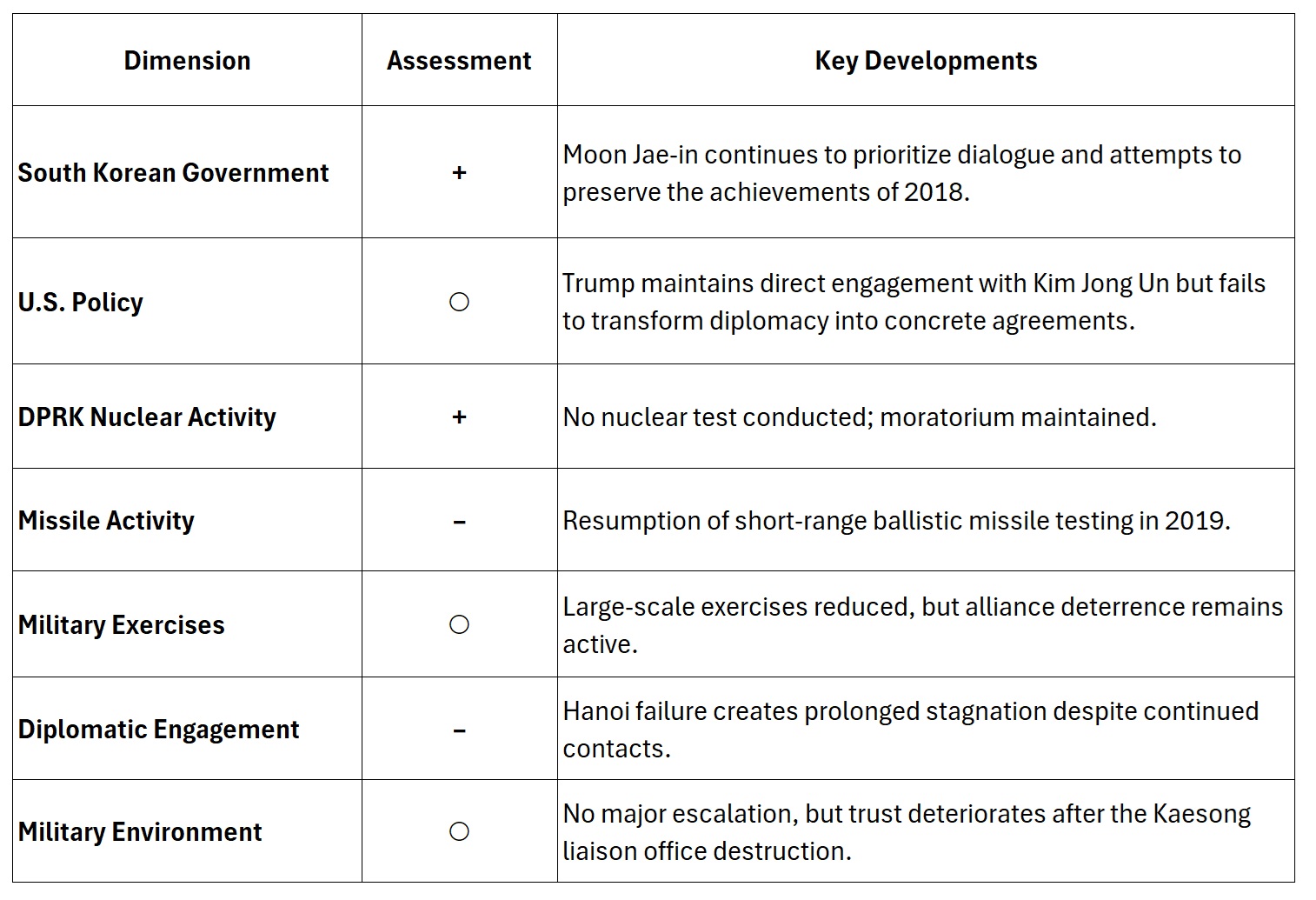
The period extending from the aftermath of the Hanoi Summit in February 2019 to the end of 2020 represents a gradual decline from the unprecedented diplomatic momentum achieved in 2018. While the atmosphere of reconciliation weakened significantly, relations between North Korea and the South Korea–United States alliance did not return to the extreme confrontation observed in 2017. Instead, the peninsula entered a phase of diplomatic stagnation characterized by unmet expectations, limited military provocations, and the gradual erosion of confidence between the main actors. A NKIO Index score of 6.0/10 reflects this intermediate situation: diplomatic progress had largely stalled, but important stabilizing factors remained, including the continued absence of nuclear testing and the preservation of some channels of communication.
The central event defining this period was the failure of the second United States–North Korea summit held in Hanoi, Vietnam, on 27–28 February 2019. The meeting between President Donald Trump and Chairman Kim Jong Un had initially generated significant expectations that the two countries could move from symbolic diplomacy toward a concrete agreement on denuclearization and sanctions relief. However, the summit ended abruptly without a joint declaration, primarily due to disagreements over the scope of North Korea's denuclearization commitments and the extent of sanctions removal demanded by Pyongyang.
The collapse of the Hanoi negotiations represented a major setback for the diplomatic process initiated in 2018. For North Korea, the failure reinforced the perception that Washington was unwilling to provide sufficient economic or political concessions in exchange for nuclear restraint. For the United States, it demonstrated that Pyongyang remained unwilling to accept a comprehensive denuclearization framework. Nevertheless, unlike the situation in 2017, both governments avoided a return to personal threats and military escalation. The diplomatic channel remained formally open, even though substantive negotiations effectively stalled.
South Korean President Moon Jae-in continued to advocate engagement throughout this period. His administration sought to preserve the achievements of 2018 and encouraged the resumption of dialogue between Washington and Pyongyang. Moon attempted to facilitate additional negotiations, including the symbolic meeting between Trump and Kim at the Korean Demilitarized Zone in June 2019, where the two leaders briefly met following the G20 Summit in Osaka. Although the encounter did not produce concrete agreements, it demonstrated that direct communication remained possible.
North Korea's behavior during this period was mixed. On one hand, Pyongyang maintained its self-imposed moratorium on nuclear tests and long-range ICBM launches established in 2018. This decision represented a significant restraint compared with the escalation of 2017 and contributed positively to the overall assessment of regional stability. On the other hand, North Korea resumed short-range ballistic missile testing in May 2019 and continued a series of launches throughout the remainder of the year. These tests demonstrated that while Pyongyang was willing to avoid the most provocative actions, it remained committed to advancing its missile capabilities.
Military tensions increased modestly but remained below the levels observed before the 2018 diplomatic opening. The United States and South Korea adjusted the scale and format of their combined military exercises, partly to preserve diplomatic space. However, disagreements emerged regarding the future of the alliance, burden sharing, and the appropriate balance between deterrence and engagement. North Korea continued to criticize joint exercises as hostile acts, but its responses remained calibrated rather than escalating toward a broader crisis.
Inter-Korean relations experienced additional setbacks in 2020. The destruction of the inter-Korean liaison office in Kaesong by North Korea in June represented one of the most visible symbols of diplomatic deterioration since 2018. Pyongyang justified the action as a response to South Korean activists sending anti-North Korean propaganda materials across the border. The incident demonstrated that trust between the two Koreas remained fragile and that symbolic gestures of hostility could quickly undermine previous achievements.
The COVID-19 pandemic further complicated diplomatic efforts in 2020. Border restrictions, economic difficulties, and the global health crisis reduced opportunities for direct engagement. Nevertheless, the period ended without a return to nuclear testing, major military confrontation, or the intense rhetorical escalation that characterized 2017.
Overall, the period from March 2019 to December 2020 represents a transition from diplomatic optimism to strategic uncertainty. The achievements of 2018 were not transformed into a lasting agreement, and relations gradually deteriorated as negotiations stalled and mutual expectations diverged. However, the absence of nuclear tests, continued restraint regarding long-range missile launches, and the persistence of diplomatic channels prevented a complete return to confrontation. A NKIO Indeex score of 6.0/10 therefore reflects a relationship that had lost its historic momentum but remained significantly more stable than during periods of maximum tension.