

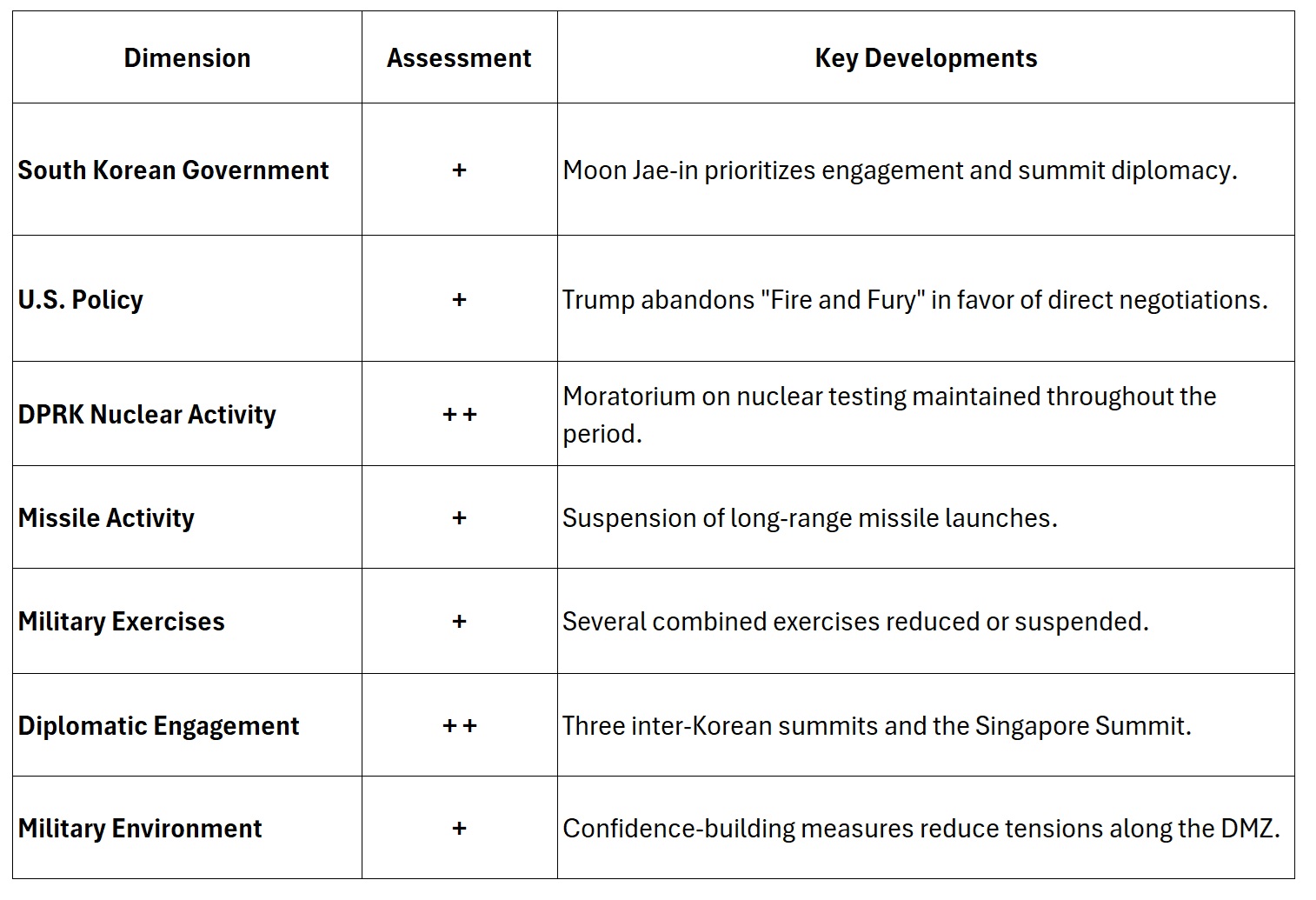
The period extending from January 2018 to the Hanoi Summit preparations in early 2019 represents the highest point in relations on the Korean Peninsula since Kim Jong Un assumed power. Following the unprecedented tensions of 2017, the regional security environment underwent a remarkable transformation as military confrontation gave way to sustained diplomatic engagement. During little more than a year, North Korea, South Korea, and the United States collectively pursued an ambitious, albeit ultimately fragile, process aimed at reducing tensions and laying the foundations for a more stable regional order. A NKIO Index score of 9.5/10 reflects this exceptional diplomatic opening, while recognizing that a permanent peace agreement and concrete denuclearization measures remained beyond reach.
The diplomatic breakthrough began with Kim Jong Un's New Year's Address on 1 January 2018. While reaffirming North Korea's status as a nuclear power, Kim unexpectedly expressed his willingness to improve inter-Korean relations and proposed North Korean participation in the upcoming Winter Olympic Games in PyeongChang. South Korean President Moon Jae-in immediately embraced the opportunity, viewing the Olympics as a catalyst for broader political dialogue. Within days, high-level inter-Korean communication channels, dormant for years, were reopened, marking the first tangible sign of détente since Kim Jong Un's accession.
The PyeongChang Winter Olympics became an unprecedented platform for diplomatic engagement. North and South Korean athletes marched together under the Korean Unification Flag during the opening ceremony, while North Korea dispatched one of its highest-level delegations to the South, including Kim Yo Jong, sister of Kim Jong Un. Her meeting with President Moon Jae-in—the first by a member of the Kim family in South Korea since the Korean War—symbolized the dramatic improvement in political relations and initiated an intensive period of summit diplomacy.
Inter-Korean engagement reached an historic milestone on 27 April 2018 with the first summit between Kim Jong Un and Moon Jae-in at Panmunjom. Kim became the first North Korean leader to cross the Military Demarcation Line into South Korea since the armistice of 1953. The resulting Panmunjom Declaration committed both governments to improving inter-Korean relations, reducing military tensions, expanding economic cooperation, and pursuing the complete denuclearization of the Korean Peninsula. Although many provisions remained aspirational, the declaration fundamentally transformed the diplomatic atmosphere.
Momentum continued throughout 2018. Kim Jong Un and Moon Jae-in held three summits during the year, including their September meeting in Pyongyang, where both leaders announced additional confidence-building measures. Military agreements established buffer zones along the Demilitarized Zone, reduced guard posts, limited military exercises near the border, and sought to minimize the risk of accidental clashes. These initiatives represented the most significant military confidence-building measures implemented since the end of the Korean War.
The most consequential diplomatic achievement occurred on 12 June 2018 when Kim Jong Un and U.S. President Donald Trump met in Singapore, marking the first summit between a sitting American president and a North Korean leader. Although the Singapore Joint Statement remained intentionally broad, it committed both countries to establishing new bilateral relations, building a lasting peace regime on the Korean Peninsula, and working toward the complete denuclearization of the peninsula. Equally important, the summit fundamentally altered the tone of U.S.–DPRK relations. The personal insults and threats exchanged only months earlier disappeared almost entirely, replaced by direct leader-to-leader diplomacy.
This period also witnessed a notable reduction in military tensions. North Korea maintained its self-declared moratorium on nuclear tests and long-range intercontinental ballistic missile launches. In parallel, the United States significantly reduced or suspended several large-scale combined military exercises with South Korea, describing the decision as a confidence-building measure intended to facilitate ongoing negotiations. Although deterrence remained intact, military signaling became considerably less confrontational than during the previous year.
Nevertheless, important structural obstacles persisted beneath the atmosphere of optimism. North Korea did not abandon its nuclear arsenal, verification mechanisms remained undefined, sanctions continued to limit economic cooperation, and significant differences persisted regarding the sequencing of denuclearization and sanctions relief. These unresolved issues ultimately prevented the diplomatic process from reaching its ultimate objective of a comprehensive peace settlement.
Overall, the period between January 2018 and February 2019 represents the closest North Korea, South Korea, and the United States came to fundamentally reshaping their relationships during the Kim Jong Un era. Diplomatic engagement replaced coercive rhetoric, military confidence-building measures reduced immediate security risks, and summit diplomacy reached an unprecedented level. While the underlying strategic disagreements remained unresolved, virtually every indicator incorporated into the Korean Peninsula Relations Index moved in a positive direction. The absence of nuclear testing, the reduction of major military exercises, the election of a strongly pro-engagement South Korean government, and the willingness of both Kim Jong Un and Donald Trump to engage directly justify assigning a NKIO Index score of 9.5/10, the highest value observed during the period under study.