

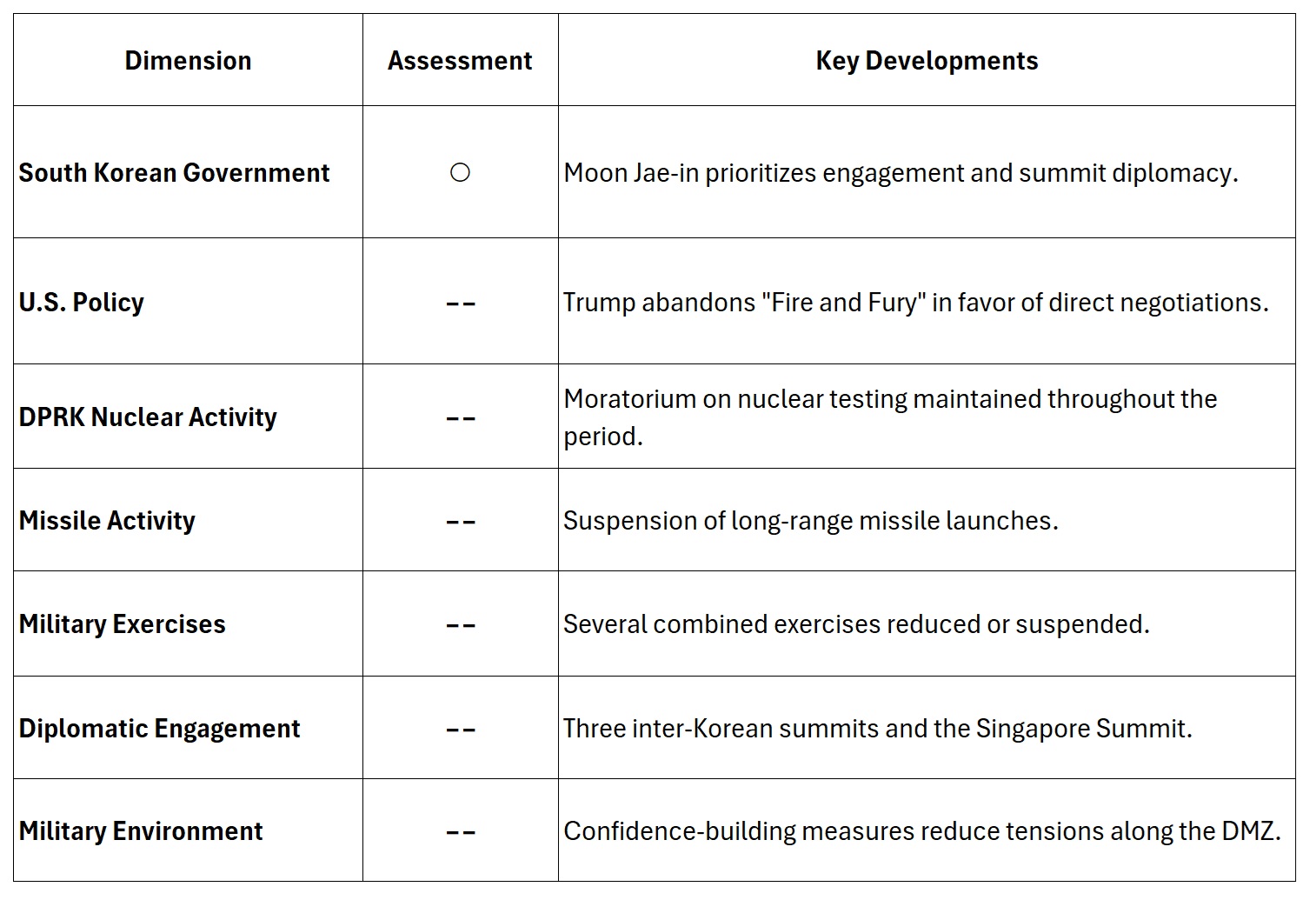
The year 2017 represents the lowest point in relations on the Korean Peninsula since Kim Jong Un assumed power in December 2011. During this period, the convergence of rapid advances in North Korea's strategic weapons programs, increasingly confrontational rhetoric from both Pyongyang and Washington, and an unprecedented display of military power created the most serious risk of armed conflict in decades. Although diplomacy was not entirely absent, particularly following the election of South Korean President Moon Jae-in in May, military deterrence overwhelmingly displaced political engagement. Consequently, a NKIO Index score of 1.5/10 accurately reflects a relationship characterized by extreme hostility while remaining marginally above the threshold associated with imminent war.
At the beginning of 2017, regional tensions were already elevated following North Korea's accelerated nuclear and ballistic missile development during the previous four years. Kim Jong Un entered the new year determined to demonstrate that the Democratic People's Republic of Korea (DPRK) had become a credible nuclear power capable of directly threatening the continental United States. Throughout the year, Pyongyang conducted an unprecedented series of missile launches, progressively increasing both the range and technological sophistication of its delivery systems.
The strategic landscape changed fundamentally in July 2017 when North Korea successfully tested the Hwasong-14 intercontinental ballistic missile (ICBM), followed by a second test later that month. These launches represented the first credible demonstration that North Korea possessed the potential capability to strike portions of the continental United States. The international response intensified further in November, when Pyongyang tested the even more advanced Hwasong-15 ICBM, claiming that it had completed its national nuclear force. Together, these developments fundamentally altered the security calculations of both Washington and Seoul.
The nuclear dimension of the crisis reached its peak on 3 September 2017 when North Korea conducted its sixth nuclear test, by far the most powerful in its history. Widely believed to have involved a thermonuclear device, the explosion demonstrated significant technological progress and reinforced concerns that North Korea was approaching the capability to field operational nuclear weapons mounted on long-range ballistic missiles. The test prompted additional United Nations sanctions and strengthened international efforts to isolate the regime diplomatically and economically.
Military signaling also intensified dramatically throughout the year. The United States and South Korea continued large-scale combined military exercises, while Washington deployed strategic assets to the region, including B-1B strategic bombers, nuclear-powered submarines, and multiple aircraft carrier strike groups operating near the Korean Peninsula. These deployments were intended to reinforce extended deterrence and reassure regional allies, but were interpreted by Pyongyang as preparations for a potential preventive strike.
Political rhetoric reached levels unseen since the Korean War. In August 2017, U.S. President Donald Trump warned that North Korea would be met with "fire and fury like the world has never seen" should it continue threatening the United States. Kim Jong Un responded by describing Trump as a "dotard" and publicly discussed the possibility of launching ballistic missiles toward the vicinity of Guam, home to major U.S. military installations in the Pacific. The exchange of personal insults between the two leaders became symbolic of a broader deterioration in diplomatic relations and significantly increased international concerns regarding the possibility of miscalculation.
Despite these extraordinary tensions, several developments prevented the situation from deteriorating further. The election of President Moon Jae-in in May 2017 introduced a government committed to re-establishing dialogue with North Korea whenever conditions permitted. Although Moon strongly supported the U.S.–ROK alliance and maintained military preparedness, he consistently advocated diplomatic engagement as the preferred long-term solution to the nuclear crisis. His administration's willingness to pursue dialogue would prove instrumental in facilitating the diplomatic breakthrough that emerged only weeks after the end of this period.
Importantly, neither Pyongyang nor Washington ultimately demonstrated a willingness to initiate direct military conflict. While the possibility of preventive military action received considerable public attention throughout 2017, both governments remained aware of the catastrophic humanitarian and strategic consequences that a second Korean War would entail. As a result, deterrence, despite its unprecedented intensity, continued to function.
Overall, 2017 constituted the most dangerous year of the Kim Jong Un era. North Korea achieved historic advances in both its nuclear and intercontinental ballistic missile capabilities, military signaling reached exceptional levels, diplomatic communication was largely replaced by coercive rhetoric, and fears of war became widespread among policymakers and analysts alike. Nevertheless, the emergence of a pro-engagement administration in Seoul during the second half of the year introduced the first indications that an alternative path remained possible. This limited but meaningful political development justifies assigning a NKIO Index score of 1.5/10 rather than the minimum value on the scale, reflecting a period that approached, but ultimately did not reach, the threshold of imminent armed conflict.