

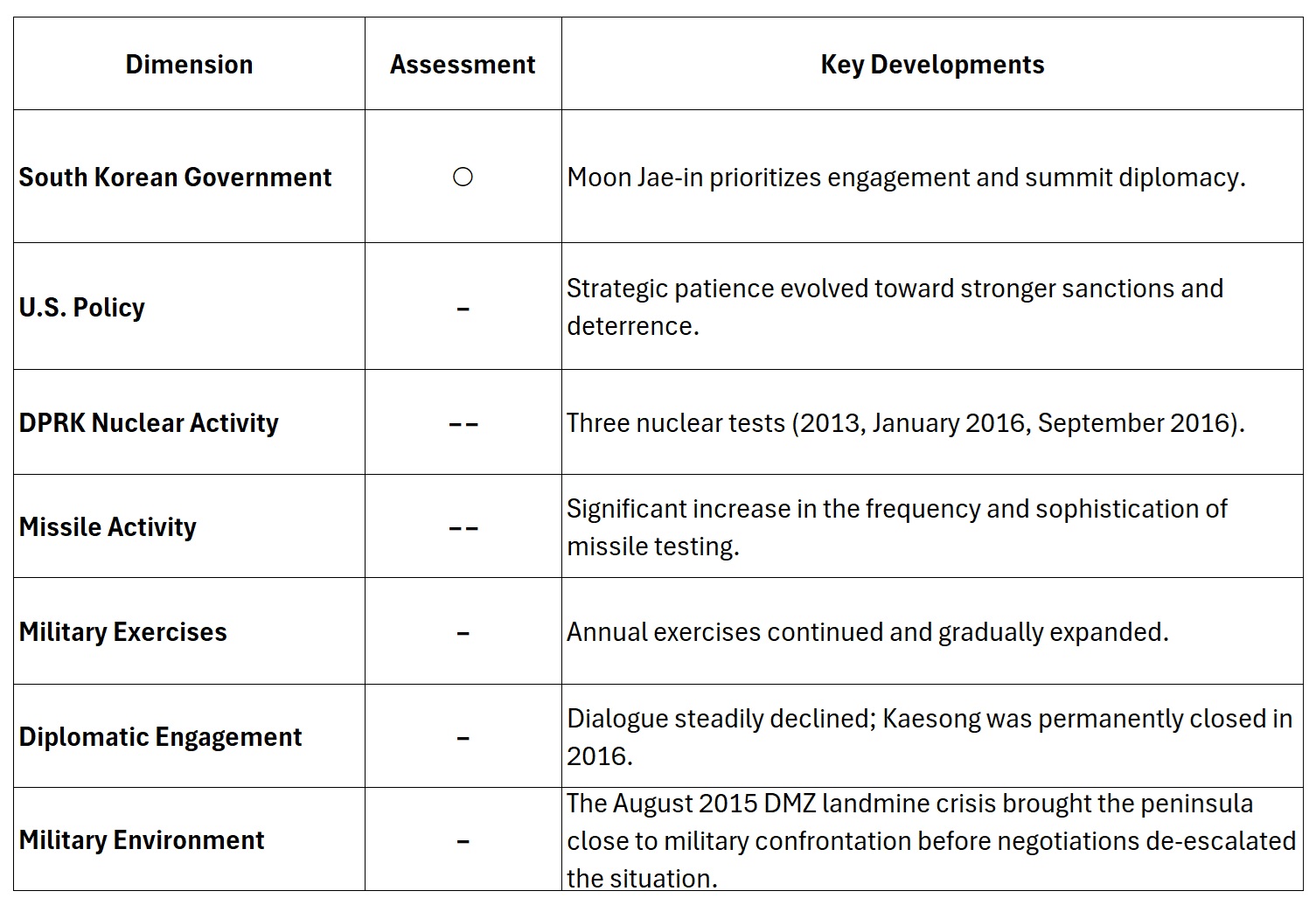
The period extending from North Korea's third nuclear test in February 2013 to the end of 2016 represents the beginning of a prolonged deterioration in relations on the Korean Peninsula. While outright military confrontation remained avoidable, diplomatic engagement steadily gave way to strategic competition, increasing mistrust, and expanding military capabilities. A NKIO Index score of 3.5/10 reflects an environment in which meaningful dialogue became increasingly rare, yet the principal actors continued to avoid the level of brinkmanship that would characterize the 2017 crisis.
North Korea's third nuclear test on 12 February 2013 fundamentally altered the regional security landscape. The test demonstrated that the new leader intended not only to preserve his father's nuclear legacy but also to accelerate its development. The test prompted stronger United Nations sanctions and reinforced the perception in both Seoul and Washington that Pyongyang had little intention of negotiating away its strategic deterrent. From this point onward, North Korea's nuclear program became the central determinant of regional security policy.
Despite this increasingly difficult environment, South Korean President Park Geun-hye initially pursued a more nuanced strategy than is often recognized. Upon taking office in February 2013, she introduced her "Trust-Building Process on the Korean Peninsula," an approach designed to combine credible military deterrence with conditional engagement. A significant escalation occurred in August 2015 following a military incident in the Demilitarized Zone (DMZ). On 4 August, two South Korean soldiers were seriously wounded by landmine explosions while conducting a routine patrol near the border. South Korea concluded that the mines had been deliberately placed by North Korean forces, an accusation that Pyongyang denied. In response, Seoul resumed psychological warfare operations through loudspeaker broadcasts directed toward North Korea, ending an eleven-year suspension of this practice.
The North Korean leadership reacted strongly, declaring that the broadcasts constituted an act of war and issuing an ultimatum demanding their removal. In the following days, both Koreas increased their military readiness, with North Korea placing frontline units on a war footing and South Korea deploying additional military assets near the border. The United States also reinforced its commitment to South Korea's defense posture. For several days, the peninsula experienced one of its most serious military confrontations since the early 2000s, demonstrating how quickly localized incidents along the DMZ could escalate into a broader crisis.
However, the crisis was ultimately resolved through high-level negotiations between the two Koreas at Panmunjom. The resulting agreement included an expression of "regret" from North Korea regarding the incident, a commitment by South Korea to end the loudspeaker broadcasts, and a pledge to improve inter-Korean relations. Although the agreement did not produce lasting diplomatic progress, it demonstrated that crisis-management mechanisms remained functional and that both sides retained an interest in avoiding uncontrolled escalation. This episode therefore contributed negatively to the NKIO index score but also prevented the relationship from descending into a more severe confrontation. Rather than abandoning dialogue altogether, Park sought to establish gradual confidence-building measures while insisting that genuine cooperation required North Korea to respect previous agreements and refrain from major provocations. Although the initiative ultimately produced few concrete results, it distinguished her administration from both the preceding conservative government and the more confrontational posture adopted after 2022.
Throughout the period, Pyongyang significantly expanded both the frequency and sophistication of its ballistic missile testing program. More importantly, North Korea conducted two additional nuclear tests in January and September 2016, the fourth and fifth in its history. These tests demonstrated measurable technological progress and suggested that Kim Jong Un had made nuclear weapons development a central pillar of regime legitimacy and national security strategy.
Relations deteriorated further following North Korea's fourth nuclear test and subsequent satellite launch in early 2016. In response, South Korea decided to permanently close the Kaesong Industrial Complex, the last major symbol of inter-Korean economic cooperation established during the Sunshine Policy era. The closure eliminated one of the few remaining institutional channels through which the two Koreas maintained regular contact and represented a significant political setback for advocates of engagement.
Another defining event occurred in July 2016 when Seoul and Washington jointly announced the deployment of the U.S. Terminal High Altitude Area Defense (THAAD) missile defense system in South Korea. While both governments argued that THAAD was a purely defensive response to North Korea's advancing missile capabilities, Pyongyang condemned the deployment as evidence of hostile intent and used it to justify further military modernization. The decision also generated significant regional repercussions, particularly in China's relations with South Korea, illustrating how the Korean Peninsula increasingly became embedded within broader strategic competition in Northeast Asia.
Military cooperation between the United States and South Korea remained robust throughout the period. Annual combined exercises such as Key Resolve and Foal Eagle continued, reinforcing deterrence while simultaneously provoking predictable condemnations from Pyongyang. Although these exercises did not yet reach the scale or political symbolism observed after 2022, they contributed to an enduring security dilemma in which each side interpreted its own actions as defensive while viewing those of its adversaries as offensive preparations.
Overall, the years between 2013 and 2016 marked the institutionalization of mutual distrust. Diplomatic initiatives repeatedly failed to gain momentum, North Korea accelerated its nuclear and missile programs, sanctions intensified, and the remaining pillars of inter-Korean cooperation largely disappeared. Nevertheless, this period remained less volatile than the crisis of 2017. Communication channels were not entirely severed, rhetorical exchanges had not yet reached their most inflammatory levels, and both Washington and Seoul continued to frame deterrence as a means of preventing conflict rather than preparing for one. The August 2015 landmine crisis represented the closest approach to military confrontation during this period and highlighted the fragility of stability on the peninsula. Nevertheless, the successful negotiation of a de-escalation agreement demonstrated that diplomatic channels had not completely collapsed. Consequently, a NKIO Indx score of 3.5/10 appropriately captures a relationship characterized by persistent deterioration, shrinking diplomatic opportunities, and growing strategic confrontation without reaching the threshold of imminent military crisis.