

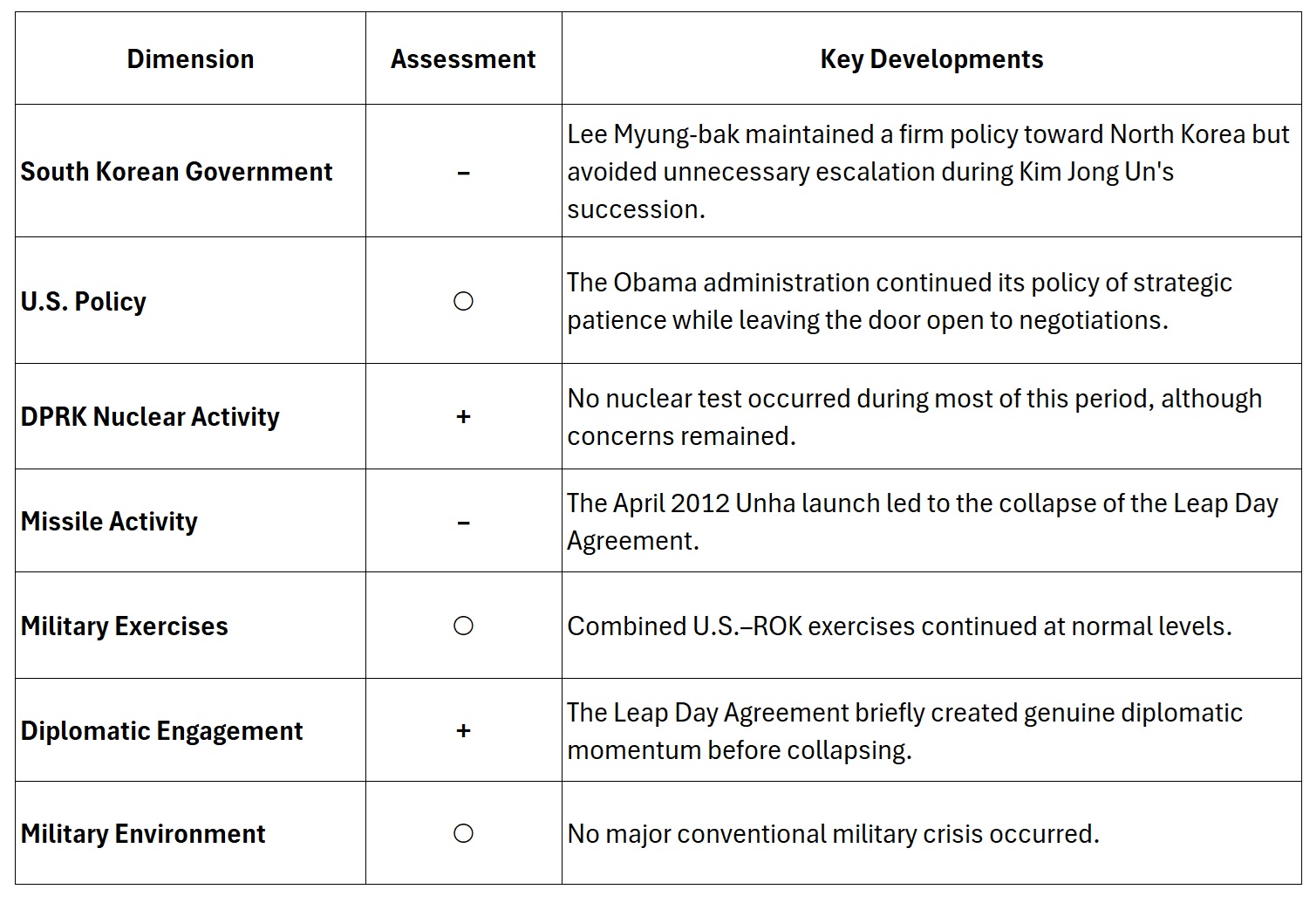
The first period of Kim Jong Un's rule, spanning from his accession to power in December 2011 until before North Korea's third nuclear test in February 2013, represents a transitional phase characterized by strategic uncertainty rather than acute confrontation. A score of 5.5 on the NKIO Index reflects a relationship that remained fundamentally adversarial but had not yet entered the cycle of sustained escalation that would define much of the following decade. During this period, all three principal actors—North Korea, South Korea, and the United States—demonstrated a degree of caution while simultaneously testing the intentions and resolve of their counterparts.
Kim Jong Un inherited power following the death of Kim Jong Il on 17 December 2011. As a young and relatively inexperienced leader, his immediate priority was the consolidation of domestic authority. Although the new leadership sought to project continuity with the policies of its predecessor, external observers remained uncertain about whether Kim would pursue economic reform, diplomatic engagement, or intensified military development. This uncertainty created a brief window during which diplomatic opportunities appeared possible.
South Korea, under President Lee Myung-bak, continued to pursue a relatively firm policy toward Pyongyang. Unlike the previous Sunshine Policy administrations, Lee conditioned meaningful engagement on demonstrable progress toward denuclearization. Nevertheless, Seoul largely refrained from actions that could unnecessarily increase tensions during North Korea's leadership transition, recognizing the potential instability associated with the succession process.
Similarly, the administration of President Barack Obama maintained its policy of "strategic patience." Rather than seeking immediate diplomatic breakthroughs, Washington emphasized deterrence, alliance coordination, and the enforcement of existing sanctions while leaving the door open to negotiations should North Korea demonstrate a credible willingness to limit its nuclear ambitions. The absence of major military crises during this period contributed to an overall environment that, while tense, remained comparatively stable.
The most significant diplomatic development occurred in February 2012 with the announcement of the so-called Leap Day Agreement. Under this arrangement, North Korea committed to a moratorium on nuclear tests, long-range missile launches, and uranium enrichment activities at Yongbyon, while the United States agreed to provide nutritional assistance. Although limited in scope, the agreement represented the first substantive diplomatic understanding reached under Kim Jong Un and suggested that both governments remained interested in exploring negotiated solutions.
This optimism proved short-lived. In April 2012, North Korea proceeded with the launch of the Unha-3 rocket, officially presented as a satellite launch but widely interpreted by the United States, South Korea, and the broader international community as a prohibited ballistic missile test. Washington considered the launch a violation of the Leap Day Agreement, leading to its immediate collapse. While the episode demonstrated the fragility of diplomatic engagement, it did not immediately trigger a broader military crisis.
Importantly, this period preceded the dramatic acceleration of North Korea's strategic weapons program. Although missile testing continued and military rhetoric remained hostile, Pyongyang had not yet conducted the series of increasingly sophisticated nuclear and intercontinental ballistic missile tests that would later dominate regional security dynamics. Likewise, the United States and South Korea continued regular combined military exercises without the exceptional scale or strategic signaling that characterized later years.
Overall, the period from January 2012 to December 2012 can best be understood as one of cautious observation rather than entrenched confrontation. Diplomatic opportunities briefly emerged, military tensions remained manageable, and none of the principal actors appeared committed to a strategy of deliberate escalation. Although the collapse of the Leap Day Agreement revealed the enduring structural obstacles to rapprochement, the Korean Peninsula had not yet entered the period of sustained hostility that followed North Korea's third nuclear test in February 2013. Consequently, a NKIO Index score of 5.5 accurately reflects a relationship situated between guarded stability and latent strategic competition.